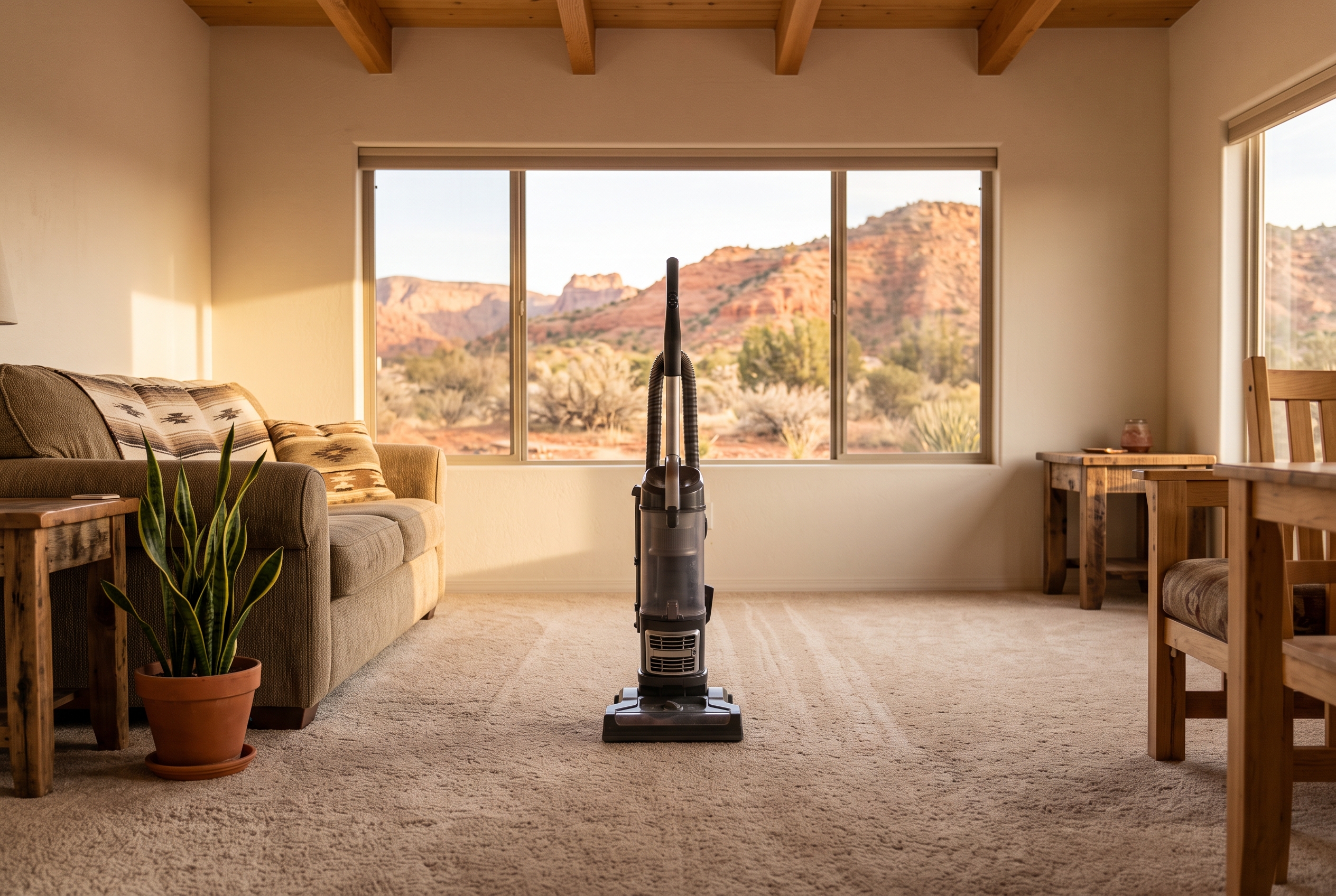
No. Vacuuming at the right setting is the best thing you can do for carpet, and a healthy carpet cannot be vacuumed too often. When a vacuum does leave damage, the cause is the setting or the machine: a brush spinning on carpet that should not have one, a head set too low, or a brush that is worn out.
Vacuuming every day is safe. The sharp grit you pick up is what wears carpet out, so busy hallways and entries last longer the more often they are vacuumed.
Loop, shag and wool carpet need the brush off. A spinning brush can snag Berber loops and fray long or wool yarn. Most cut pile is the opposite and needs the brush on.
A head set too low fuzzes the surface. The brush drags through the yarn tips and untwists them. Set too high, the vacuum skims over the grit.
Strong suction and robot vacuums are fine with a few adjustments. A sealed, powerful head can grip soft carpet and chew rug fringe, and most robots have no height setting.
Stripes and fuzz are normal. Light and dark streaks after vacuuming are shading, and fuzz in the bin from new carpet is loose fiber that tapers off.
| Situation | Harms carpet? | What to do |
|---|---|---|
| Vacuuming every day | No | Keep going, especially entries |
| Brush on, loop or Berber | Yes, it can snag | Brush off or raised |
| Head too low, worn brush | Yes, it fuzzes tips | Raise head, replace brush |
| Strong sealed suction | Rarely, on soft carpet | Lower suction, raise head |
| Robot vacuum | No, on most cut pile | Keep it off fringe and shag |
| Light and dark stripes | No, it is shading | Finish passes one way |
| Fuzz from new carpet | No | Vacuum it out |
Does Vacuuming Wear Out Carpet?
No, vacuuming does not wear out carpet. The sand and grit you walk into it do. Each grain is a tiny piece of rock with sharp edges, and every step rubs it against the fibers down near the backing, where you cannot see it. Shaw's care guide compares the effect to sandpaper, and that is how it behaves.
Carpet hides this well, which is part of the problem. Today's fibers are made to hide soil and bounce light, so a carpet can look clean while the bottom of the pile is full of grit. That grit gathers where people walk: the path from the garage door to the kitchen, the strip in front of the sofa, the top of the stairs.
Those paths get ground the hardest. Over time the fibers there are scratched until they look lighter and duller, and the pile flattens. That is why carpet wears out in lanes while the corners still look new.
A vacuum can wear the surface itself in one situation: when its brush is too aggressive for the carpet, set too low, or worn down to stubs. That damage shows up as fuzz and frayed tips, never as gray lanes, and it stops the day you fix the setting.
Our soil makes all of this matter more here. The red sand and fine dust around St. George stay dry and loose most of the year. Rock and gravel yards shed grit onto every walkway, and summer storm mud dries into the same sand. The carpet inside your doors and along your busiest paths needs the most vacuuming, and it pays you back in years.
Can You Vacuum Carpet Too Much?
No, you cannot vacuum carpet too much if the vacuum is set correctly. Fabrica, whose carpets we carry, tells its owners in plain words that you cannot over-vacuum and that vacuuming should start the day the carpet is installed. Daily passes on a busy carpet are a good habit.
When people say they ruined a carpet by vacuuming too much, the real problem is almost always a bad setting repeated every day. A brush that is too low, worn, or spinning on loop pile does a little harm on each pass. Fix the setting and the frequency stops mattering.
How often you should vacuum depends on how many feet, paws and grains of sand cross the carpet. Vacuum the whole house at least once a week, and hallways, stairs and the carpet inside outside doors more often. Add more passes if you have pets. In a house beside a gravel yard or open desert, the first few feet inside each door earn a quick pass every day.
| Where | Lanes and entries | Whole room |
|---|---|---|
| Bedrooms, guest rooms | Once or twice a week | Once a week |
| Living and family rooms | Two or three times a week | Once a week |
| Halls, stairs, entries | Every day or two | Twice a week |
| Homes with pets | Every day | Twice a week |
Pets bring hair and dander along with the dirt on their paws. Hair weaves into cut pile, so leave the brush on there and go slowly. On loop carpet and on furniture, a rubber-bristle pet tool pulls hair loose without snagging anything.
How you vacuum matters as much as how often. Move slowly, at the pace of a calm walk, so the air has time to pull grit up from the base. Push forward and pull back over the same strip, and overlap each strip by a few inches.
Give traffic lanes several slow passes in two directions; two slow passes clean more than four fast ones. In a vacation rental or a guest casita, vacuum after every stay, since a week of guests can track in a month of sand.
Which Vacuum Setting to Use on Your Carpet
The right setting is the one where the brush just touches the tips of the pile and the vacuum still pushes easily. If your vacuum asks whether the brush should be up or down, put it down for most cut pile, and up or off for loop, shag and wool.
To know which of those you have, look closely at the surface. If the yarn bends over and goes back in, it is loop, and Berber is the best-known loop style. If you see cut yarn ends, it is cut pile: smooth plush and saxony, tightly curled frieze, or long, loose shag. A mix of the two in a pattern is cut-and-loop. Wool shows on the label, and your installation invoice or the tag on a leftover piece names the style.
To find the right height on a vacuum with a manual setting:
- Start at the highest setting with the brush roll on.
- Run the vacuum over a few feet of carpet and lower it one notch at a time.
- Stop at the notch where the vacuum starts to pull itself forward slightly and you can hear the brush working.
- If it drags, bogs down, or the carpet looks fuzzier after a pass, go back up a notch.
- Test any new vacuum or setting in a closet first, where a mistake will not show.
Set too high, a vacuum cannot reach the grit near the backing. Set too low, the brush rubs the yarn tips until they fuzz and look worn.
Look at the brush roll every few months, too. Bristles worn to stubs, hair and string wound around the roll, and nicks or burrs on it all scrub the carpet rather than sweep it. Run a finger along the bottom of the vacuum head as well, because a rough edge or a bent plate there drags across the pile on every pass.
| Carpet | Brush roll | Height | Watch for |
|---|---|---|---|
| Plush, saxony, textured | On | Brush just touching | Shading lines |
| Berber, loop | Off or raised | High | Snags and runs |
| Cut-and-loop patterns | Off or raised | High | Snagged loops |
| Frieze, long pile | Off if it tangles | Highest | Yarn on the brush |
| Shag | Off | Highest or hand tool | Wrapped yarn |
| Wool, wool blends | Off or lifted | High | Fuzzing, pilling |
| Extra-soft (SmartStrand) | On | Raise until it glides | Hard to push |
Plush, Saxony and Other Cut Pile
Cut-pile carpet, the plush, saxony and textured styles in most bedrooms and living rooms, needs the brush roll on. You may have read that beater bars ruin carpet, but on cut pile the spinning brush is what lifts the yarn and knocks grit loose from the base. Suction alone cannot do that on a dense pile. Shaw asks for a rotating brush on every one of its styles except long-yarn shag.
Set the height so the bristles touch the tips and go no lower. If you like the even, freshly groomed look on a plush, finish the room with passes all in one direction, ending at the door so you do not walk on it.
Berber and Other Loop Carpet
Berber and other loop carpet should be vacuumed with the brush roll off, or raised so the bristles cannot reach the loops. A spinning brush can hook a loop, and on some loop carpets one hooked loop pulls the next, the way a snag runs in a sweater. Thick, chunky loops and wool loops are the most at risk.
Vacuum with suction only, on a high setting, and go slowly so the airflow does the work. Cut-and-loop patterns, where some yarn is cut and some is looped to make a design, follow the same rule. If one loop stands taller than its neighbors, trim it level with scissors before you vacuum over it again.
Frieze, Shag and Other Long Pile
Frieze, the tightly twisted carpet with a curly look, does best at the highest height setting, and casual frieze with longer yarn may need the brush off altogether. Yarn wrapped around the brush roll after one room is the sign.
Shag should always be vacuumed with suction only, because its long yarns wrap around a spinning brush and get pulled and frayed. On a deep shag or a thick rug, the hand nozzle or upholstery tool on the hose often works better than the floor head, which sinks in and chokes. A carpet rake, pulled gently, stands the pile back up afterward.
Wool and Wool Blends
Wool carpet does best with a suction-only vacuum, or one whose brush lifts clear of the pile. The wool makers we carry advise against beater bars, because over time a brush distorts wool pile and changes the look of the surface. Wool loop is the most sensitive of all, and a regular brush can make it pill.
An upright or canister with the brush turned off is the simplest tool for wool. New wool also sheds more than most carpet in its first months, which is normal and harmless.
SmartStrand and Other Extra-Soft Carpet
If your vacuum is hard to push on soft carpet, the carpet is not too thick; the vacuum's suction is sealing against it. Very soft carpets, such as the Mohawk SmartStrand styles we carry and other fine, dense fibers, pack so many filaments into the surface that a strong, sealed head grips them like a suction cup.
Raise the height a notch or two until the head glides. Open the suction-control vent on the handle if your vacuum has one, and turn the motor or brush speed down if it allows. If you are shopping for a vacuum for soft carpet, look for a manual height setting, wide wheels that do not sink into the pile, a lighter machine and a brush you can switch off. A vacuum you have to force across your carpet is also working the yarn too hard.
What to Look For in a Vacuum for Carpet
The best vacuum for carpet is one you can adjust: a manual height setting, a switch that turns the brush roll off, and a way to turn suction down. With those, one machine can handle a plush bedroom, a Berber family room and a wool rug. Without them, a vacuum may be fine on one carpet and rough on another.
Check the box for the Carpet and Rug Institute's Seal of Approval. Vacuums that carry it have passed independent lab tests for how much soil they remove, how well they keep dust inside the machine, and whether the carpet still looks good afterward. Most carpet makers ask you to use a certified vacuum.
Upright vacuums with adjustable heads are the most practical choice for wall-to-wall carpet. Canisters are easier on stairs, and with a powered head they clean cut pile well. Stick vacuums are handy for daily passes on entries and lanes, though many have a fixed height.
Whichever you own, keep the brush clean, replace it when the bristles wear down, and empty the bin or change the bag before it is full. A full vacuum loses airflow and leaves grit behind.
Strong Suction and Stick Vacuums
Strong suction does not wear out carpet by itself, but a powerful, sealed head can cause two problems. On soft, dense carpet it grips the pile and makes the vacuum hard to push, so you shove harder and drag the brush through the yarn. On area rugs it can lift the edge, swallow the fringe and wind it around the brush, which is where the stories about pricey stick vacuums chewing up rugs come from.
Turn the suction down on soft carpet and on rugs if your vacuum allows it, and raise the head. On rugs, switch to a soft-roller or floor head if your vacuum came with one. If your stick vacuum has a stiff, fast brush bar that cannot be turned off, keep it to cut-pile carpet and hard floors.
Robot Vacuums on Carpet
Robot vacuums are fine on most cut-pile carpet, and in a sandy house they help, because a daily run picks up surface grit before anyone walks it in. Most robots have no height setting and a brush that is always on, though, so a few carpets need care.
Keep the robot off shag, off rugs with fringe, and off loop carpet with loose or pulled loops; most robot apps let you draw no-go zones for those spots. Turn off any mopping pad before it crosses carpet. Keep a weekly full pass with an adjustable upright too, since a robot's light, quick passes do not reach the grit at the base of the pile.
Telling Vacuum Damage From Wear, Shading and Shedding
Most things that look like vacuum damage are not. Light and dark streaks, gray lines along the walls and fuzz in the bin are normal carpet behavior. A fuzzy surface and a pulled loop usually are setting problems, and you can stop both today.
| What you see | What it is | What to do |
|---|---|---|
| Light and dark streaks | Shading, not damage | Finish passes one way |
| Gray lines at walls, doors | Filtration soiling | Specialist cleaning |
| Fuzz in the bin | Normal shedding | Keep vacuuming |
| Fuzzy, frayed surface | Brush too low or worn | Raise height, new brush |
| Pulled loop or run | Brush caught a loop | Trim; brush off |
| Gray, flat traffic lane | Grit wear, crushing | Deep clean; more passes |
Lines and Footprints After You Vacuum
Light and dark stripes after vacuuming are shading, and shading is not damage. The vacuum leans the pile one way, and light bounces off the sides of the yarn differently than off the tips, so one stripe looks lighter than the next. Footprints show for the same reason.
Shading is most noticeable on solid-color plush, saxony and velvet carpet. The industry does not count it as a defect, and a carpet that shades will keep doing it. If the stripes bother you, finish each room with slow passes all in one direction, or groom the pile with a carpet rake. If you are choosing new carpet and hate seeing footprints, textured, frieze and patterned styles hide shading far better than a smooth plush.
Gray or dark lines along baseboards, under doors, at the edges of stairs and around air vents are something different, called filtration soiling. Air moving through the gap under a door or along the carpet edge carries fine dust, and the carpet strains it out like a filter. The vacuum did not cause it and will not remove it. It takes a specialist cleaning treatment, and changing your air filters on schedule slows it down.
Fuzz in the Vacuum After New Carpet
Fuzz in the bin after new carpet goes in is shedding, and it is normal. Carpet spun from staple fiber, short lengths twisted into yarn, holds loose bits from manufacturing that work their way up for months. Removing them does not shorten the carpet's life, and with steady vacuuming most shedding fades within the first year. Wool and some polyester styles shed the most.
You can vacuum new carpet the day it goes in, and you should. Empty the bin often in the first weeks so the vacuum keeps its airflow. If one tuft stands up taller than the rest, that is a sprout: snip it level with the pile using sharp scissors and never pull it, because pulling can draw out a whole row of yarn.
A Fuzzy or Frayed Surface
Fuzzing, a hairy or frayed look on the surface, means the yarn tips have untwisted. The usual causes are a brush set too low, a worn or nicked brush, scrubbing at a spill, or chair legs and toys dragged over the same spot. Each untwisted tip frays a little, and together they make the patch look dull and worn.
Start with the cause: raise the vacuum height, check the brush roll and replace it if the bristles are short or the roll is nicked, and blot spills rather than scrubbing them. Trim any pills level with sharp scissors. Fuzzed yarn does not twist back up, so the goal is to keep the patch from spreading. A deep cleaning will even out its look but will not restore it.
A Pulled Loop or a Run in Berber
If a loop is sticking up out of your Berber, trim it, and never pull it. Snip it level with the loops around it using sharp scissors, then turn the brush roll off before you vacuum that carpet again, since the brush is almost always what caught it. A single trimmed loop disappears into the pattern.
A run, where a whole row of loops has pulled out, needs a repair. The usual fix is to cut out the damaged strip and set in a matching piece, which is why it pays to keep the leftover carpet from your installation rolled up in a closet. Until it is repaired, keep the brush off that carpet so the run does not grow.
Gray, Flattened Traffic Lanes
When a traffic lane stays gray and matted even after vacuuming, grit has worn it. The fibers are scratched, so they look lighter and duller than the carpet beside them, and the pile has lost thickness from being walked on, which carpet people call crushing. When the yarn tips untwist and tangle as well, that is matting.
A professional deep cleaning lifts the soil that darkens the lane and can fluff the pile, so a lane often looks better afterward. It cannot unscratch fibers or re-twist yarn. To slow it down, give the lane extra passes and put a mat at the door that feeds it. Moving a rug or a chair now and then also helps, because the steps fall in a slightly different place.
Carpet Powders and Other Things That Do Harm Carpet
Yes, carpet deodorizing powders can harm both your carpet and your vacuum. Most are built on baking soda, a fine, gritty mineral, and a vacuum does not lift all of it. What stays behind scratches the fibers the same way sand does and can turn a traffic lane gray.
Over time, the powder's alkalinity can also weaken the latex that holds the carpet's backing together. Inside the vacuum, it clogs filters and wears plastic parts.
For odor, go after the source instead. Vacuum slowly and thoroughly, blot pet accidents right away and treat them with an enzyme cleaner made for carpet, tested first on a hidden spot. Then open the windows, run the fan on your heating and cooling system, and let the next deep cleaning take care of the rest.
A few everyday habits do more harm than any vacuum. Scrubbing a spill untwists the yarn and leaves a fuzzy patch, so blot from the outside in with a white cloth, and rinse out any cleaner with plain water, because leftover soap pulls dirt back in fast. Household vacuums are also not built for fine drywall dust or fireplace ash. That powder clogs the filter, and a shop vacuum with a fine-dust filter is the tool for those jobs.
How to Vacuum Stairs, Edges and Area Rugs
Stairs, edges and rugs need attachments and a slightly different method, because the floor head either cannot reach them or is too rough for them. A few minutes with the hose once a week keeps grit from building up where the main head never goes.
- Stairs: work from the top step down, so loosened dirt falls onto steps you have not done yet. Use a powered hand tool or the upholstery tool on each tread.
- Run the crevice tool along the back corner of each step, where the tread meets the riser and grit collects.
- Give the nosing, the rounded front edge of each step, a slow pass every time. It takes more wear than any other carpet in the house.
- Edges: run the crevice tool along the baseboards weekly. Most floor heads leave an inch or two along the wall untouched.
- Under furniture: use the hose or a low-profile head, and move lighter pieces every few weeks.
- Under a rug that sits on carpet: lift the rug and vacuum the carpet beneath it every few weeks. Grit sifts through and gets ground in by the rug's weight.
Area rugs are lighter than wall-to-wall carpet and have loose edges, so they need a gentler touch. Vacuum across the fringe rather than into it, or lift the head as you reach the end. Turn the brush off on wool, loop and shag rugs, the same as on carpet. A few times a year, flip the rug, vacuum the back, and vacuum the floor under it, because a surprising amount of sand sifts through.
Deep Cleaning and What Your Carpet Warranty Expects
Vacuuming removes dry soil, but the oily film and fine grit deep in the pile need a deep cleaning every 12 to 18 months. That is the range the carpet makers we carry ask for, and heavy traffic, pets and our dust push it toward the short end.
Hot-water extraction, often called steam cleaning, is the method most carpet makers specify. It sprays hot water and a cleaning solution into the pile and pulls it straight back out with strong suction, taking the loosened soil with it.
Whoever cleans your carpet, ask for solutions and equipment certified under the Seal of Approval program. Ask that the carpet be vacuumed first, rinsed well so no soap is left behind, and not soaked, so it dries within a day. If you rent a machine and do it yourself, the same certification rule applies to the machine and the solution.
Most carpet warranties cover things like wear, texture and stains, and in return most expect two things from you: regular vacuuming, usually with a certified vacuum, and periodic professional cleaning. The paperwork that comes with your carpet is what counts. Keep it in a folder with your cleaning receipts in case you ever need them.
Keeping Red Dust and Grit Off Your Carpet
The cheapest way to make carpet last in a desert home is to stop the grit before it reaches the pile. Every grain that stays outside is one your vacuum never has to chase and your carpet never has to wear against.
- Put a coarse scraper mat outside every door you use and an absorbent mat inside, long enough that people take a few steps on it before they reach the carpet.
- Shake or vacuum the mats often, and wash them when they look full. A mat packed with sand starts handing it back.
- Take shoes off at the door if your household will do it. It is the biggest single cut in tracked-in grit.
- Wipe dogs' paws after walks and yard time, especially after a storm turns the yard to red mud.
- Keep gravel and sand from spilling onto the walkways to your doors, and sweep the porch and the garage step often.
- Change your heating and cooling filters on schedule, since fine dust the system recirculates settles back on the carpet.
- Let tracked-in mud dry, then vacuum it up before you clean what is left. Wet red clay smears and stains; dry, it vacuums out.
If the floor right inside your door takes a beating, the entry itself may be the place for a hard surface. Our guide to entryway flooring that stands up to sand and red dirt covers what holds up best at the threshold.
When Carpet Is Worn Out, Not Just Dirty
Carpet is worn out when cleaning no longer brings it back. Look for lanes that stay flat and gray after a professional cleaning, backing showing through on stair nosings, seams opening, or an odor that keeps returning because it lives in the pad. If you are not sure, have it deep cleaned first. Dirty carpet will surprise you; worn carpet will not change.
Some problems look like the end and are not. Ripples and bumps in wall-to-wall carpet usually mean it has loosened over its pad and needs re-stretching with a power stretcher. A single damaged spot can often be patched from leftover carpet. Replacing a room is for wear you can see everywhere people walk.
At Sunset Flooring in St. George, we help you choose your next carpet with everything the last one taught you. Our carpet catalog lets you filter by fiber, from nylon and polyester to wool and triexta, with makers including Shaw Floors, Mohawk, Masland, Fabrica, Anderson Tuftex and Dream Weaver.
You can have samples sent to your door to see them in your own light. If you want new carpet down quickly, start with the carpet we keep in stock, and if you would rather talk it through, book a design consultation with us.
Bruce and Beckie Barber have been providing flooring and installation across Southern Utah since 1991, and you can see every style in person at our showroom on East Gateway Drive. If spreading the cost helps, our financing options are a click away.
Questions People Ask About Vacuuming Carpet
Can You Vacuum Wet Carpet?
No, not with a regular household vacuum. Water pulled into a dry vacuum can ruin the motor, and it turns any soil in the carpet into mud that smears deeper. Blot up as much as you can with white towels, weigh the towels down with something heavy that will not bleed color, and dry the carpet completely with fans before you vacuum. A wet-dry shop vacuum is fine for a spill of clean water.
Should You Vacuum Before the Carpet Cleaner Comes?
Yes. Dry soil comes out best while it is dry, and a well-vacuumed carpet comes out of a deep cleaning cleaner, because the cleaning solution is not turning loose grit into mud. Vacuum slowly the day before, with extra passes on lanes and entries.
Should You Vacuum Against the Pile?
Yes, and with it too. Passes against the lay of the pile lift it and pull out more grit, and crossing them with passes the other way cleans better than either alone. On a plush, make your last passes go with the pile, toward the door you leave by, for the smooth look.
Does a Bagged or HEPA Vacuum Matter for Allergies?
Yes, for what you breathe while you vacuum. A vacuum that holds its dust well, which is part of what the Seal of Approval test checks, puts less of it back into the air. For anyone with dust or pet allergies, a sealed vacuum with a HEPA filter, or a bagged machine you empty outdoors, is the better choice. Vacuuming while the allergic person is out of the room helps too.
If your carpet has reached the point where no setting or cleaning will bring it back, we would be glad to help with what goes down next. Request a free estimate and meet with one of our project specialists about the rooms you have in mind.