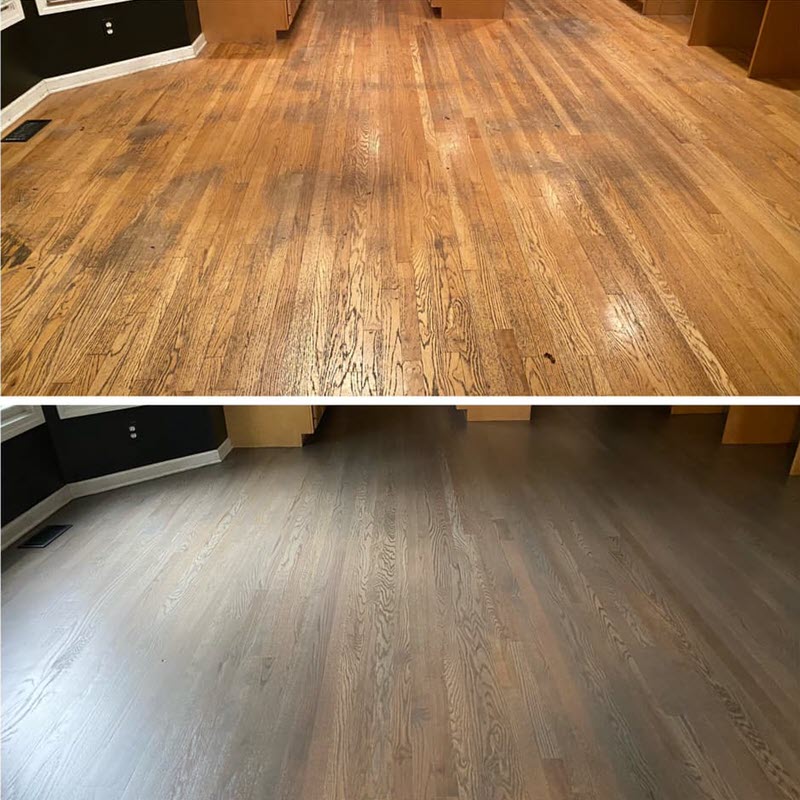
You glance across your living room and notice the once-rich wood tone has dulled, boards are a little gapped, and years of desert dust and kids’ shoes have left their mark. The big question hits: do you breathe new life into your existing hardwood with a refinish, or is it finally time to replace it altogether? In a dry, high-UV climate like St. George, the right answer isn’t always obvious.
Tag: refinish-vs-replace-wood
How Desert Climate Changes the Refinish vs. Replace Equation
In the Mojave Desert, hardwood doesn’t just age; it dehydrates. Single-digit humidity pulls moisture from solid wood, which can cause shrinking, cupping, cracking, and permanent gaps. At the same time, intense sunlight pouring through large windows can bleach finishes and weaken surface coatings.
If the boards themselves are structurally sound—no major movement, no deep cracks—sanding and refinishing can restore color, remove surface scratches, and apply a tougher modern finish. But if your floor has widespread warping, severe gaps that collect grit, or boards that move underfoot, refinishing becomes more of a bandage than a solution.
This is where engineered options shine. Many homeowners who decide to replace older solid wood end up exploring engineered hardwood options designed for dry climates, because cross-layered cores handle Southern Utah’s low humidity far more gracefully than traditional planks.
Signs Your Hardwood Is a Good Candidate for Refinishing
Refinishing makes sense when the underlying wood is still healthy. In our experience, your floor may be a strong refinishing candidate if:
- Scratches and dents are mostly in the finish, not deep gouges into the wood
- Boards feel firm and stable, with no “spongy” or loose areas
- Gaps are hairline, not wide channels that trap red sand
- There’s no evidence of water damage, dark staining, or rot around kitchens or exterior doors
When these boxes are checked, sanding down to fresh wood and applying a high-performance finish can dramatically change how your floor looks and performs. It’s especially effective for homes in older parts of St. George where original hardwood adds character you want to preserve.
There is an important caveat in this region: every sanding cycle removes material. If your floor has already been refinished multiple times, there may not be enough thickness left for another safe sanding. At that point, even if the surface looks “okay,” replacement is the smarter long-term investment.
When Replacement Is the Smarter Long-Term Investment
Sometimes an aging hardwood floor is telling you it’s time to start over. We typically recommend replacement instead of refinishing when:
- Boards are severely cupped, twisted, or cracked from years of dry-air movement
- There are soft spots, extensive pet damage, or deep stains that sanding can’t fully remove
- You want to change the layout, remove transitions, or reconfigure walls
- The floor has already been sanded to its safe limit
For many homes in Bloomington Hills and similar neighborhoods with large glass walls, replacing with engineered wood lets you keep the warmth of real hardwood while dramatically improving dimensional stability. You can preview different grain patterns, plank widths, and tones by browsing the full hardwood catalog with visualizer tools before we ever step onto your job site.
If you’re rethinking the entire main level, it can also be a great time to coordinate other surfaces. Some homeowners pair wood in living spaces with cool, low-maintenance tile in entries or around patios, using the porcelain and ceramic tile selections to handle the highest-traffic, sand-heavy zones.
Protecting Your Investment from UV and Future Damage
Whether you refinish or replace, the fastest way to shorten the life of your floor is to leave it exposed to full-strength sun. UV light doesn’t just fade color; it weakens finishes and accelerates drying, amplifying the very problems you’re trying to solve.
We strongly encourage pairing any new hardwood project with thoughtfully designed window treatments that block or diffuse direct rays during peak hours. If you’re dealing with big south- or west-facing glass, exploring custom window coverings that manage UV and heat is just as important as choosing the right plank.
Equally critical is who installs your new floor. Proper acclimation, subfloor prep, and expansion detailing are non-negotiable in this climate. Our team’s professional flooring services and installation expertise are built around those building-science realities so your new hardwood performs as beautifully as it looks.
If your wood floors are starting to show their age and you’re unsure whether to refinish or replace, we’re happy to walk the space with you, measure, and talk through the science, costs, and design options. When you’re ready, you can schedule a technical in-home estimate for your hardwood project.