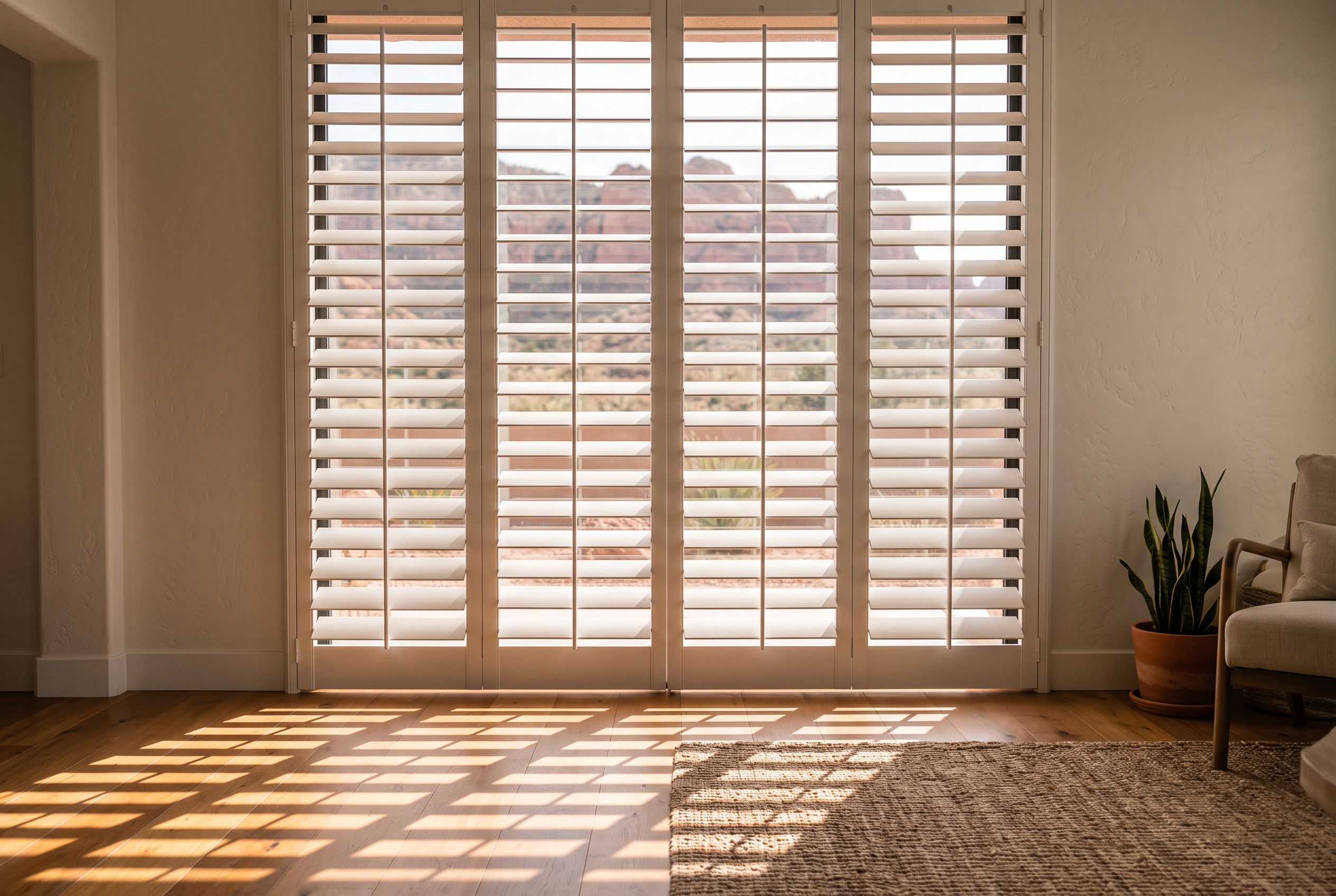
Plantation shutters are worth it when you plan to stay in your home for years, the windows are ones you live with every day, and the shutter is built for the sun that window gets. They are usually not worth it when the budget has to stretch over every window at once, when you want a room fully dark or softly draped, or when you expect to move soon.
Staying put for years: worth it. Shutters outlast fabric coverings, need no replacing as styles change, and look like part of the house.
Selling in a year or two: usually not. They stay with the house, but no reliable study shows buyers pay back their full cost.
Hot west and south windows: worth it, if the material suits the heat. There is no fabric to fade, and a well-built shutter shrugs off years of sun.
Bedrooms: worth it with a blackout layer. Louvers let light in at the edges, so light sleepers pair them with a blackout shade.
Sliders and odd shapes: sometimes. Shutters can cover a sliding door or an arch, but the track, the stack and the cost need a closer look.
| Your situation | Worth it? | Why |
|---|---|---|
| Staying several years | Yes | Lasts, no restyling needed |
| Selling soon | Usually not | Payback is uncertain |
| Hot west or south glass | Yes, right material | No fabric to fade |
| Bedroom, light sleeper | With a blackout layer | Light leaks at louvers |
| Sliding glass door | Sometimes | Needs track and stack room |
| Tight budget, many windows | Mix and match | Shutters where they show most |
What Plantation Shutters Are
Plantation shutters are interior shutters with wide, horizontal louvers set into a frame fitted to the window. You tilt the louvers with a rod down the middle of the panel or a hidden mechanism at the side, and you swing the whole panel open on hinges when you want the full window. Traditional shutters use narrow louvers. Plantation shutters use wider ones, for a cleaner look and more view between them.
Full-height panels cover the whole window. Tier-on-tier panels stack two sets, so you can open the top and keep the bottom closed. Cafe shutters cover only the lower part of a window, and a divider rail across a tall panel lets the top and bottom louvers tilt separately.
You may also hear "plantation blinds." That usually means a wood or faux-wood blind with wide slats. From across the street it looks similar, but it raises on cords like any blind and has no fixed frame.
What Plantation Shutters Cost and Why
Plantation shutters cost more than blinds and most shades, often several times as much per window, because each one is built to order with solid panels and a frame fitted to that opening. Your price depends far more on your windows and your choices than on any national average, so the useful question is what moves the number.
| What you choose | Effect on price | Notes |
|---|---|---|
| Material | Large | Real wood usually costs most |
| Window size | Large | Priced by area or panel |
| Shape | Large | Arches and angles cost more |
| Sliders, French doors | Large | Tracks, more panels |
| Louver size | Small to moderate | Wider can save panels |
| Hidden tilt, finish | Small to moderate | Custom colors add |
| Number of windows | Total, not per window | Whole rooms look best |
Most of the price is in how they are made. A shutter is a piece of joinery: a frame cut and joined to fit one opening, panels assembled from rails, stiles and louvers, a tilt system, hinges and a finish, then fitted and adjusted in place. A blind is a standard part cut to width. That difference is why shutters cost more, and why they last longer.
The comparison that matters is cost over the years you live there. A blind or fabric shade on a sunny window often gets replaced as the fabric fades, the cords fray or the style dates. A well-built shutter can stay as long as you own the house, so the longer you stay, the more the gap narrows.
You do not have to shutter every window. Put shutters where they are seen and used most, such as the street-facing windows, the great room and the primary bedroom, and use cellular shades or blinds in closets, laundry rooms and back bedrooms. Sliders, arches and very large windows are where shutters cost the most, so weigh those one at a time.
When you compare quotes, make sure each spells out the material, louver size, frame style, tilt type, finish, number of panels per window, and whether installation is included. Two quotes that differ in price often differ in one of those lines.
We price shutters at a free estimate, window by window, so the number reflects your sizes and choices. If spreading the cost helps, look at our financing options.
Wood, Composite or Vinyl Shutters
Wood, composite and vinyl shutters each suit different rooms. Four things decide which you want: how much moisture the room sees, how hot the window gets, the finish you want, and how big the panels are. Each is a good choice somewhere.
| Material | Strengths | Watch for | Best rooms |
|---|---|---|---|
| Real wood | Light, stiff, stainable | Standing water, steam | Living areas, bedrooms |
| Composite | Sealed, paint finish | Weight on big panels | Most rooms, kitchens |
| Poly or vinyl | Moisture-proof, durable | Reinforcement on hot glass | Baths, laundry, kitchens |
Real wood, often basswood, is light and stiff, so it makes long louvers and wide panels that stay straight. It is also the only choice if you want a stained finish that shows the grain. It dislikes standing water and steam, so it is a weaker fit for a shower wall or the window over a sink.
Composite shutters have an engineered-wood core sealed under a durable painted finish. They handle kitchen humidity well, look like painted wood, and usually cost less than real wood. They are heavier, which matters on very large panels.
Poly or vinyl shutters are solid synthetic, so water does not bother them, which makes them the natural pick for bathrooms and laundry rooms. On hot glass, ask how the long louvers and the panel sides are reinforced, because the air between closed louvers and a west-facing window gets very hot on summer afternoons.
Whatever the material, a hot west or south window calls for three checks. Ask how the maker rates that product for heat and sun. Keep long louvers within the lengths the maker recommends. And choose a white or light finish, which reflects more heat and hides dust.
Painted whites come in many shades, so match yours to the window trim with a sample in your own light. You can tell the materials apart in a sample by weight, since wood is the lightest, and by the cut ends, where real wood shows its grain.
Louver Size, Frames and Mounting
Louver size sets the look and the view. Two-and-a-half-inch louvers have a traditional feel and fit shallow windows. Three-and-a-half-inch louvers are the common middle ground. Four-and-a-half-inch louvers give the most open view and the most modern look, with fewer louvers per panel.
Wider louvers need more room to tilt. When they open, they swing toward the glass and toward the room, so the window frame must be deep enough to clear the glass, the window cranks and any handles. On a shallow frame, a shutter frame mounted on the wall around the window, or a narrower louver, solves it.
Frames come in several profiles. Some sit inside the window opening, while others mount on the wall or trim around it and add a finished edge of their own. A divider rail lets you tilt the top and bottom separately, which is useful on a tall street-facing window. Hidden tilt replaces the rod down the middle with a mechanism in the side of the panel, for a cleaner look and a clearer view.
Plantation Shutters vs Blinds and Cellular Shades
Shutters win on looks, durability and the feel of a finished house. Blinds win on price and simplicity, and cellular shades win on heat and darkness. Which one is right depends on what matters most at each window.
| Factor | Shutters | Blinds | Cellular shades |
|---|---|---|---|
| Look | Built-in, architectural | Simple, familiar | Soft, clean |
| Heat blocking | Good | Fair | Best inside the glass |
| Darkness | Light at edges | Light at slats | Blackout available |
| Durability | Longest | Moderate | Moderate |
| Cleaning | Wipe louvers | Wipe slats | Vacuum gently |
| Cords | None | Often | Cordless available |
| Cost | Highest | Lowest | In between |
On heat, shutters are good but not the best. Closed louvers block direct sun, but light and heat slip around the louver edges and the frame, while cellular shades trap air in their cells and come out ahead in national-lab comparisons.
Shutters have no cords at all, which is a real advantage with young children in the house. The Consumer Product Safety Commission urges cordless window coverings anywhere small children live or visit, and a shutter meets that by design. Shutters are also sturdy enough for a dog that likes to watch the street.
Blinds and cellular shades raise completely out of the way, while shutters swing open and take a little room in front of the window. If you like to change the look of a room every few years, fabric coverings are easier to swap.
Do Plantation Shutters Add Value to Your Home?
Yes, in the sense that buyers see them as a built-in upgrade, but nobody can promise you a percentage back. Shutters are mounted to the window frames, so they usually stay with the house when it sells, and your purchase contract's list of included items decides it. The often-repeated claim that shutters return most of their cost at sale has no study behind it.
To make them count at sale time, keep the color the same on every window facing the street. Choose white or a soft neutral that suits most tastes. Put them in the rooms buyers notice first: the front rooms, the great room and the primary bedroom. A home you plan to sell next year, or a rental's back bedrooms, are where shutters are least likely to pay you back.
How Shutters Hold Up in Desert Sun
Shutters are among the most sun-tolerant window coverings, because there is no fabric to fade or rot and no cord to fray. A well-made shutter on a west window can look the same after years of afternoon sun that would wear out most shades.
The sun still has effects to plan for. UV slowly yellows or chalks some finishes, so a factory-applied finish matters. The air trapped between hot glass and closed louvers gets far hotter than the room, which is why reinforcement and heat rating matter on west and south windows. And our wind leaves a fine dust on every louver.
Closed in the hot hours, shutters also keep the sun off your floors and furniture, which is half the reason to cover a sunny window here. Our post on window coverings that protect new floors from Southern Utah sun goes into that. On the very hottest glass, a slim shade between the glass and the shutter, where the frame is deep enough, adds heat blocking.
Light, Privacy and Sleep
Shutters give you finer control of light and privacy than almost any other covering, but they do not make a room fully dark. Tilt the louvers up and the sun bounces off the ceiling while neighbors see only louver edges. Tilt them down for a view of the yard, or close them for privacy with a soft glow at the edges.
In a bedroom, that glow is the catch. Wider louvers that close tightly help, and some frames add light-blocking strips, but light sleepers usually pair shutters with a blackout shade. In a bathroom, a moisture-proof material and a divider rail let you keep the lower half closed while the top lets in light.
Shutters for Sliding Doors, French Doors and Arched Windows
Shutters for sliders and other odd openings are possible, but they take more planning and cost more. On a sliding glass door, the panels either slide on a track (bypass) or fold back on themselves (bifold), and you need wall space beside the door for them to stack when it is open.
French doors take panels mounted to each door, with cutouts or careful sizing around the handles so the doors still open and lock. Arched windows take a fixed sunburst panel over the shutters, or shutters shaped to follow the arch.
Bay and corner windows need frames that meet cleanly where the windows meet, so the panels clear each other when they open. Crank-out windows and shallow frames need the louver size checked against the crank handle and the depth before anything is ordered.
How to Clean Plantation Shutters
Clean plantation shutters with a weekly dusting, because our dry wind leaves a fine film on every louver. The routine takes a few minutes:
- Close the louvers one way and dust them with a microfiber cloth or a duster, working from the top down.
- Close them the other way and repeat, so both faces get cleaned.
- Vacuum the frame and the louver edges with a soft brush attachment now and then.
- For marks, wipe with a cloth barely dampened with water and a drop of mild dish soap, then dry right away.
Shutters near a kitchen or bathroom sink can pick up spots from our hard water. Wipe them with a damp cloth and dry them before the minerals set. Keep wood shutters away from soaking-wet cloths and spray cleaners that run into the joints, and skip harsh solvents and abrasive pads on any finish.
When Shutters Sag, Stick or Warp
Shutters that sag, stick or flop usually need an adjustment, not a replacement. Louvers that fall shut or drift open have lost tension. Most panels have small tension screws in the side, which you tighten a quarter turn at a time until the louvers hold their angle.
A panel that sags or rubs the frame usually needs its hinge screws tightened. Doors that will not stay closed need their magnets or catches adjusted. A tilt rod that has pulled loose from a louver can often be reset at its small staple.
Warping is different. A panel or louver that has bowed from heat or moisture usually has to be replaced, which is the best reason to match the material to the window from the start. A finish that has yellowed in strong sun can be refreshed on wood, while synthetic shutters are usually replaced.
How to Tell Well-Made Shutters
Shutter quality shows in the hand: a well-made shutter is square, solid and smooth, and you can check most of that with a sample. Start at the corners of the frame and panel. Joints that are glued and doweled or interlocked hold up far better than ones held only by staples.
Tilt the louvers to a few angles and let go; they should stay put and move smoothly. Open and close the panel; the hinges should feel solid and the panel should not sag. Run your hand over the finish, which should be smooth and even with no drips at the louver ends. On poly or vinyl, ask whether the longer louvers and the panel sides are reinforced.
How long shutters last depends on how they are built and what the window puts them through. The warranty that comes with the product is the maker's own view of that, so read what it covers, such as warping, finish and hardware, and for how long.
Choosing Shutters With Us
At Sunset Flooring in St. George, shutters are one of the window coverings we specialize in, along with blinds, honeycombs and verticals. Our owners, Bruce and Beckie Barber, have worked in flooring, window coverings and installation here since 1991, and Bruce's training at Mohawk University covered window coverings right through to wooden shutters.
Look over our window coverings, and stop by our showroom on East Gateway Drive to talk through your windows. Whenever you compare shutter samples, check the joints, the tilt and the finish for yourself.
Questions People Ask About Plantation Shutters
Are Plantation Shutters Out of Style?
No. Shutters read as part of the architecture rather than a trend, especially in white or a soft neutral. Wider louvers and hidden tilt give them a current look.
Can You Install Plantation Shutters Yourself?
You can with stock sizes and a square window frame. Custom shutters, though, depend on exact measurements and a frame that is square and level, and a shutter that is off by a fraction of an inch rubs, gaps or will not close. Measure three times, at the top, middle and bottom, and check the frame for square before ordering anything yourself.
How Long Do Custom Shutters Take?
The lead time for custom shutters is weeks rather than days, because they are built to order after the windows are measured. Plan ahead if you want them up before the summer heat or before guests arrive.
Are Shutters Good With Kids and Pets?
Yes, shutters are good with kids and pets. They have no cords, the panels are sturdy, and a louver knocked out of line tilts right back. If a pet likes to look outside and scratches the lower louvers, a tier-on-tier style lets you open the top half and keep the bottom closed.
Shutters are the covering you will see and touch every day for years, so judge them in person. Book a free estimate, note the windows you want shuttered, and we will price them one by one.