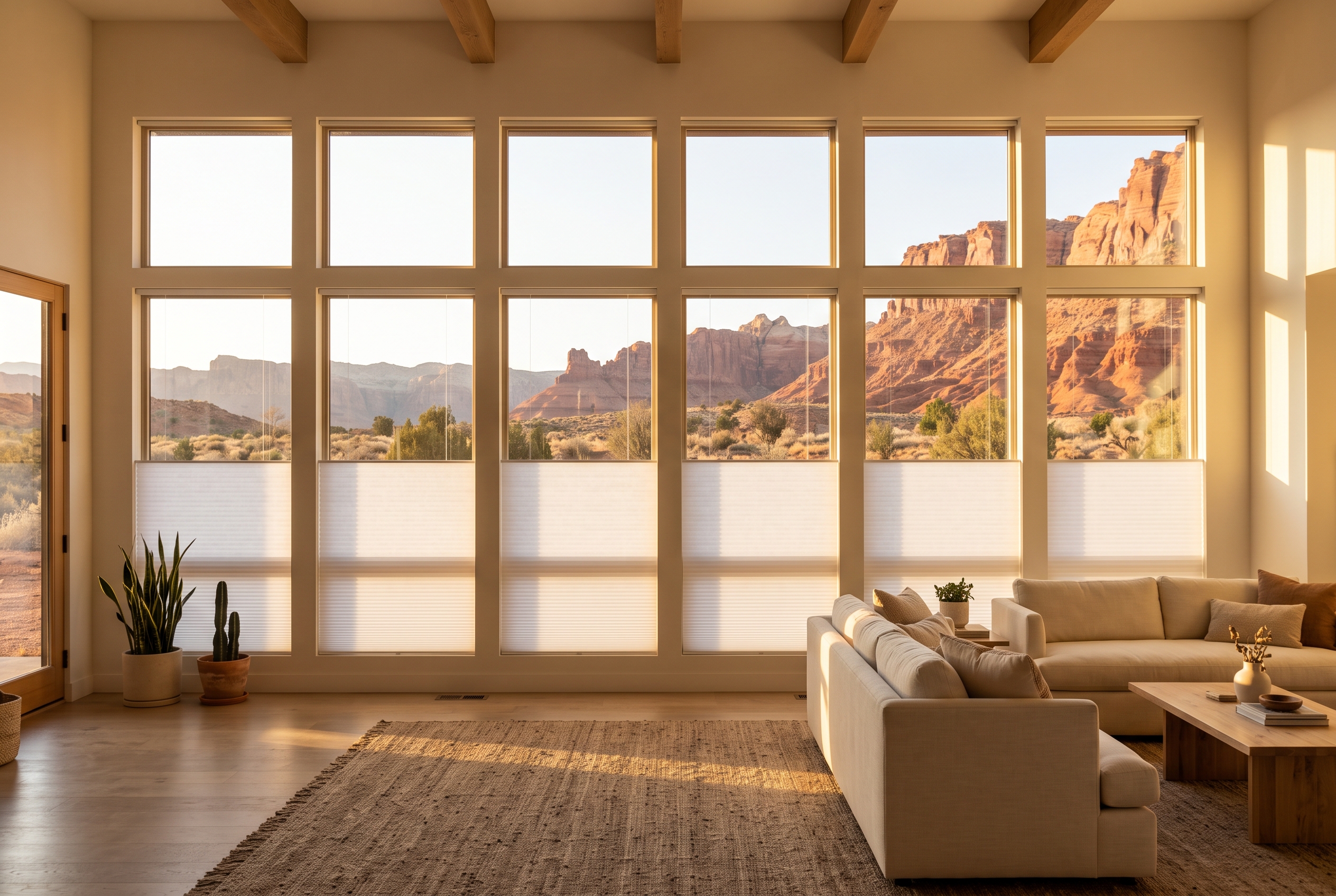
Cellular shades, also called honeycomb shades, keep out more heat than any other covering that hangs inside the window. The rule behind that: the covering that keeps a room coolest stops the sun close to the glass and seals the edges of the window, so the heat never spreads into the room. Which covering is best for you still depends on the window.
West- and east-facing windows: cellular shades. Low morning and afternoon sun hits this glass straight on, and a double-cell shade with a light backing, fitted tight, does the most.
Sliding glass doors: vertical cellular shades or vertical blinds. Both stack to the side for the door, and the cellular version insulates far better.
Bedrooms: blackout cellular shades. They block light for sleep and heat for comfort in one layer, which a single-layer blackout shade does not.
Windows you want to see out of: solar screen shades or top-down cellular shades. You trade some heat blocking for the view.
If you love the look of shutters: shutters, closed in the hot hours. They block direct sun well, though light and heat slip around the louvers and frame.
| Covering | Heat blocking | Light and view | Best for |
|---|---|---|---|
| Cellular (honeycomb) | Best inside the glass | Filtering to blackout | Hot windows, bedrooms |
| Shutters | Good when closed | Adjustable louvers | Looks, privacy, sun |
| Blinds | Fair; little insulation | Adjustable slats | Light control, budget |
| Vertical blinds | Fair | Rotate and stack | Sliders, wide glass |
| Solar screen shades | Fair to good | Keeps the view | Views, glare, UV |
| Blackout roller | Fair; blocks light | Dark | Media rooms |
| Lined drapes | Good when closed | Open or closed | Layering over shades |
How the Sun Heats a Room Through the Glass
The sun heats a room by passing through the glass and turning into heat when it lands on your floor, furniture and walls. A covering inside the window can fight that in two ways. It can bounce sunlight back out through the glass before it is absorbed, or it can hold a layer of still air between the hot glass and the room. The best coverings do both.
Which windows matter most depends on where they face. East windows take the low morning sun straight on, and west windows take the low, hot afternoon sun, which is the hardest to stop because it comes in nearly level. South windows get high summer sun, so a roof overhang often shades them at midday. North windows get little direct sun at all.
Here, that afternoon sun arrives when the air outside is already past 100 degrees for much of the summer, so a west-facing great room or bedroom is where coverings earn their keep. Newer dual-pane, low-e windows already cut some of the heat, and a good covering adds to them rather than replacing them.
Shading on the outside of the glass, such as an awning or an exterior screen, stops even more heat than anything inside, because the sun never gets through the window. Inside the window, the choice of covering and how well it fits are what you control, and they make a real difference.
Do Cellular Shades Keep Heat Out?
Yes, and the reason is air. The pleated fabric of a cellular shade folds into honeycomb cells that trap still air, and the shade holds another pocket of air between itself and the glass. Some are made with reflective surfaces inside the cells to bounce back more of the sun. The Department of Energy's summary of national-lab simulations found cellular shades saved more energy than every other type of shading device studied.
Cell count is the first choice to make. Single-cell shades are the lightest and least expensive. Double-cell shades trap two layers of air and are the usual pick for a hot west window. Triple-cell shades insulate the most and stack a little thicker when raised.
Light is the second choice. Light-filtering fabrics soften the sun and still brighten the room. Blackout fabrics have a lining that blocks light completely, which suits bedrooms and media rooms and adds to the heat blocking.
Top-down, bottom-up shades lower from the top as well as raise from the bottom. On a street-facing window you can cover the lower glass for privacy and heat while letting daylight in over the top.
Fit matters as much as fabric. A cellular shade fitted closely inside the frame, with small gaps at the sides, holds its air layer far better than one that hangs loose. Honeycomb shades are one of the products we specialize in.
Are Shutters Good for Keeping Heat Out?
Yes, shutters are good at keeping heat out, though not the best. With the louvers closed, a shutter blocks direct sun and adds a solid layer between the glass and the room. Light and heat still find their way around the edges of each louver and the frame, so a shutter does not hold a sealed layer of air the way a fitted cellular shade does.
To get the most from shutters in summer, close them before the sun reaches the glass, and tilt the louvers so their upper edges point toward the window, which sends light up and away. A white or light finish on the window side reflects more sun than a dark stain.
On a deep window frame, a slim shade can sit between the glass and the shutter for the hottest windows, and in a bedroom a blackout shade behind shutters gives you both the look and the dark. Shutters are another of the products we specialize in.
Do Blinds Keep Heat Out?
Yes, but only partly. Closed blinds keep direct sun off your floor and furniture, but they do little to insulate, so much of the heat that builds up on the slats still reaches the room. They block some sun and add little insulation, which is why they sit behind cellular shades and shutters for heat.
You can help them along. Close the slats fully on a sunny window, with the curved side facing up toward the glass, so they reflect sun back out and up. Light-colored and metallic slats reflect more than dark stains. Mount them as tight to the frame as the window allows, because the gaps at the sides let sun through all day.
Wood blinds and standard blinds are among the products we carry, and they are a good fit where you want adjustable light at a lower price. On a very hot west window, ask which slat material is rated for that heat, since the air between the glass and the slats gets very hot on summer afternoons.
Sliding Glass Doors and Big Patio Windows
For a sliding glass door, choose a covering that stacks to the side: vertical cellular shades for the most heat blocking, or vertical blinds for the most light control. A slider is usually the biggest piece of glass in the house and the one people walk through, so the covering has to move out of the way.
Vertical blinds turn their vanes to follow the sun through the day and stack neatly at one side, and they are one of the products we specialize in. Vertical cellular shades slide sideways like a curtain and bring the honeycomb's trapped air to the whole door, which makes them the better choice for heat on a west-facing patio door.
Whatever you choose, cover more than the glass. Extending the covering a few inches past the frame on each side and at the top cuts the bright, hot strips of sun that otherwise come in around the edges.
Roller, Solar and Blackout Shades
Blackout describes light, not heat. A single-layer blackout roller shade makes a room dark, but it holds no layer of air, so a good share of the heat it absorbs still reaches the room. A blackout cellular shade does both jobs, which is why it is the better bedroom choice in our summers.
Solar screen shades are woven to cut glare, UV and some heat while you keep looking out. The tighter the weave, the less sun and heat get through and the less you see. A darker fabric gives a clearer view out, while a lighter one reflects more sun. They suit view windows and home offices, where glare on a screen is the real problem.
Plain roller shades in a light-filtering fabric are simple and tidy and cut glare, but they insulate less than cellular shades.
Drapes and Layered Window Coverings
Lined drapes help keep heat out when they are closed, reach the floor, and close snugly at the top and sides. The lining and the air between the drapes and the glass do the work, and a white or light lining facing the window reflects more sun.
The strongest inside combination is a shade at the glass with drapes over it. A cellular shade does most of the heat work, and the drapes add another layer plus softness and color. It is a common look in great rooms with tall windows.
Does a Light or Dark Covering Keep a Room Cooler?
It depends on which side faces the glass, because that side decides how much sun bounces back out. A white or reflective backing sends more of it back through the window, while a dark one absorbs it and passes the heat inward. The side that faces the room can be any color you like, which is why many shades come with a white back and a colored front.
Solar screen shades are the one exception worth knowing. There, a darker fabric is easier to see through, so you trade a little heat for a clearer view. Light colors also show sun fading less over the years.
Inside Mount, Outside Mount and the Gaps Around the Edges
Heat and light leak around the edges of a covering, so how it fits matters as much as what it is. An inside mount sits within the window frame for a clean look and a close fit, as long as the frame is deep and square enough. An outside mount sits on the wall over the window and overlaps the glass by a few inches on each side, which covers gaps and works on shallow or uneven frames.
Custom sizes fit closer than stock sizes cut down to the nearest inch, and that close fit is what lets a cellular shade hold its air layer. On a west window, a quarter inch of gap down each side can throw a bright stripe of sun across the room all afternoon.
Which Covering for Which Room
Each room in a typical St. George home asks for a different covering, and the right one starts with which windows take the afternoon sun.
| Room | First choice | Also works |
|---|---|---|
| West great room | Double-cell shades | Shutters, layered drapes |
| Kitchen and dining | Top-down cellular | Blinds, shutters |
| Bedroom | Blackout cellular | Shutters plus blackout |
| Nursery | Cordless blackout cellular | Cordless shutters |
| Home office | Solar screen or top-down | Blinds |
| Bathroom | Moisture-safe cellular | Faux-wood blinds |
| Sliding door | Vertical cellular | Vertical blinds |
Great Rooms and West-Facing Living Areas
Great rooms with west-facing walls of glass are the hottest rooms in many local homes. Double-cell shades closed before the afternoon sun arrives do the most there. If you want the look of shutters or drapes, layer them with a shade at the glass.
Kitchens and Dining Rooms
Kitchens need light to work by. Top-down cellular shades cover the lower glass in the heat of the day while letting daylight in over the top, and blinds or shutters give quick control over a sink window.
Bedrooms and Nurseries
Bedrooms want dark and cool together, which is what blackout cellular shades deliver. In a nursery or any room where young children sleep or play, choose cordless coverings. The Consumer Product Safety Commission calls cordless coverings, or ones whose cords cannot be reached, the only safe option where young children are present.
Home Offices and Screen Glare
In a home office, glare on the screen is as much a problem as heat. Solar screen shades keep the view and cut glare, and top-down shades or angled blinds let you aim the light away from the monitor.
Bathrooms
Bathrooms need coverings that tolerate steam. Cellular shades made for humid rooms handle it well, and faux-wood blinds shrug off moisture that would warp real wood.
Arched, High and Hard-to-Reach Windows
Arched tops and high clerestory windows let in a lot of sun that is hard to reach. Fixed shapes cover arches, and for high windows a motorized shade that closes on a schedule saves you from forgetting the one window that heats the room every afternoon.
When to Close Them, and What It Saves
Close each covering before the sun reaches that window, and open it again once the sun has moved on. Once sunlight has warmed the floor and furniture, the heat is already inside.
| Window faces | Close by | Open again |
|---|---|---|
| East | Early morning | Late morning |
| South | Late morning | Mid-afternoon |
| West | Early afternoon | After sunset |
| North | Rarely needed | Any time |
In the cooler months the rule flips. Open south-facing coverings on sunny winter days to let the sun warm the house, and close everything at dusk so cellular shades can hold the heat in overnight.
Measured results give a sense of what it saves. The Pacific Northwest National Laboratory tested two identical houses through a summer. The one with insulating cellular shades kept closed used about 13 percent less heating and cooling energy than its twin with white vinyl blinds. That was one test in one climate, but it is a measured result rather than a sales claim.
Your own savings depend on how much west- and east-facing glass you have, what that glass already does, how faithfully the coverings get closed, and where the thermostat sits. Motorized shades that close on a timer take the faithfulness out of it, which matters most for high windows and for second homes that sit empty in the summer.
Keeping the sun off also protects what is inside. Direct sun fades floors, rugs and upholstery and dries out wood floors, which we cover in more depth in our post on protecting new floors with the right window coverings.
How to Compare Energy Ratings on Window Coverings
The Attachments Energy Rating Council, an independent nonprofit, rates window coverings on a label with two numbers, and the one that matters for a hot climate is the Warm Climate rating. It estimates how much the product can cut air-conditioning energy. The other number, the Cool Climate rating, does the same for heating.
Higher is better, and so is closer to the "Max" printed for that type of product. Every type has its own Max because some products can save much more than others. Any rating over zero saves energy compared with a bare window, and you can compare Warm Climate numbers across types, such as a cellular shade against a blind.
A few other details on the label are worth knowing. "Not Applicable" means the product is not recommended for energy savings in that climate. Automated products show a second, higher rating for when the shade closes on a schedule. The solar heat gain coefficient, where it appears, measures how much of the sun's heat gets through, and lower is better for a hot window.
Not every product carries a rating, and a covering without one is not necessarily a poor performer. When you are comparing two shades for a hot window, though, the label is the closest thing to an independent test you will find while shopping.
When Window Coverings Fail in the Heat
If your coverings are bowed, faded or brittle, or the room still bakes with them closed, the heat at the glass is usually behind it. Summer afternoons heat the air between the glass and a closed covering well past room temperature.
Slats that bow or droop have been softened by that heat. Open them slightly during the hottest hours if they keep bowing, and when you replace them, choose a material rated for hot windows. Fabric that fades or turns brittle and cords that fray have taken years of UV, and the fix is a replacement in a UV-resistant fabric, ideally cordless.
Cellular shades whose cells have flattened or sagged no longer trap air as well, so replace those on your hottest windows first. If a room is still hot with everything closed, check for gaps at the sides, a dark backing facing the glass, or coverings being closed after the sun is already in. Some windows simply take more sun than any inside covering can stop, and those are where exterior shading earns its cost.
Dust is the everyday problem, since our wind carries fine dust that settles on slats and louvers. Dust blinds and shutters weekly with a microfiber cloth or a soft vacuum brush, and vacuum cellular shades gently on low suction with a brush attachment.
Choosing Window Coverings With Us
At Sunset Flooring in St. George, we specialize in blinds, honeycombs, shutters, verticals and standard blinds, which covers most of what keeps a hot room comfortable. Bruce and Beckie Barber have been providing flooring, window coverings and installation to the area since 1991, and Bruce trained at Mohawk University in window coverings from cellular blinds to wooden shutters.
What a covering costs depends on the window's size and shape, the type and cell count, light-filtering or blackout fabric, the lift system (corded, cordless or top-down), and whether it is motorized. We price your windows at a free estimate, so the number reflects what each window actually needs.
See the range on our window coverings page, or come look in person at our showroom on East Gateway Drive. If new floors are part of the plan too, book a design consultation, and our financing options can spread the cost.
Questions People Ask About Window Coverings and Heat
Do Window Coverings Help in Winter Too?
Yes. Cellular shades closed at night hold heat in and cut drafts near the glass, which helps on our cold desert winter nights. On sunny winter days, open the south-facing coverings to let the sun warm the house for free.
Is Window Film Better Than Shades for Heat?
They do different jobs. Film on the glass works all day and keeps the view, but it is always on, even in winter when you would welcome the sun. Shades insulate, open when you want light, and add privacy. On a very hot west window, the two work well together.
Should I Close the Blinds When I'm Away?
Yes, close the blinds and shades on every sunny window in summer. A closed-up house holds its temperature better while the air conditioning is set back, and your floors and furniture fade less. In a second home or vacation rental, motorized shades on a schedule do it for you.
Are Cordless Shades Worth It?
Yes, in any home where young children live or visit, and they look tidier in every home. Cords are a strangulation hazard for small children even when tied up, so cordless lifts or motorized controls are the safe choice.
If the afternoon sun is winning in your house, start with the windows that face it. Request a free estimate, check window coverings on the form, and one of our project specialists will help you sort out which windows need what.