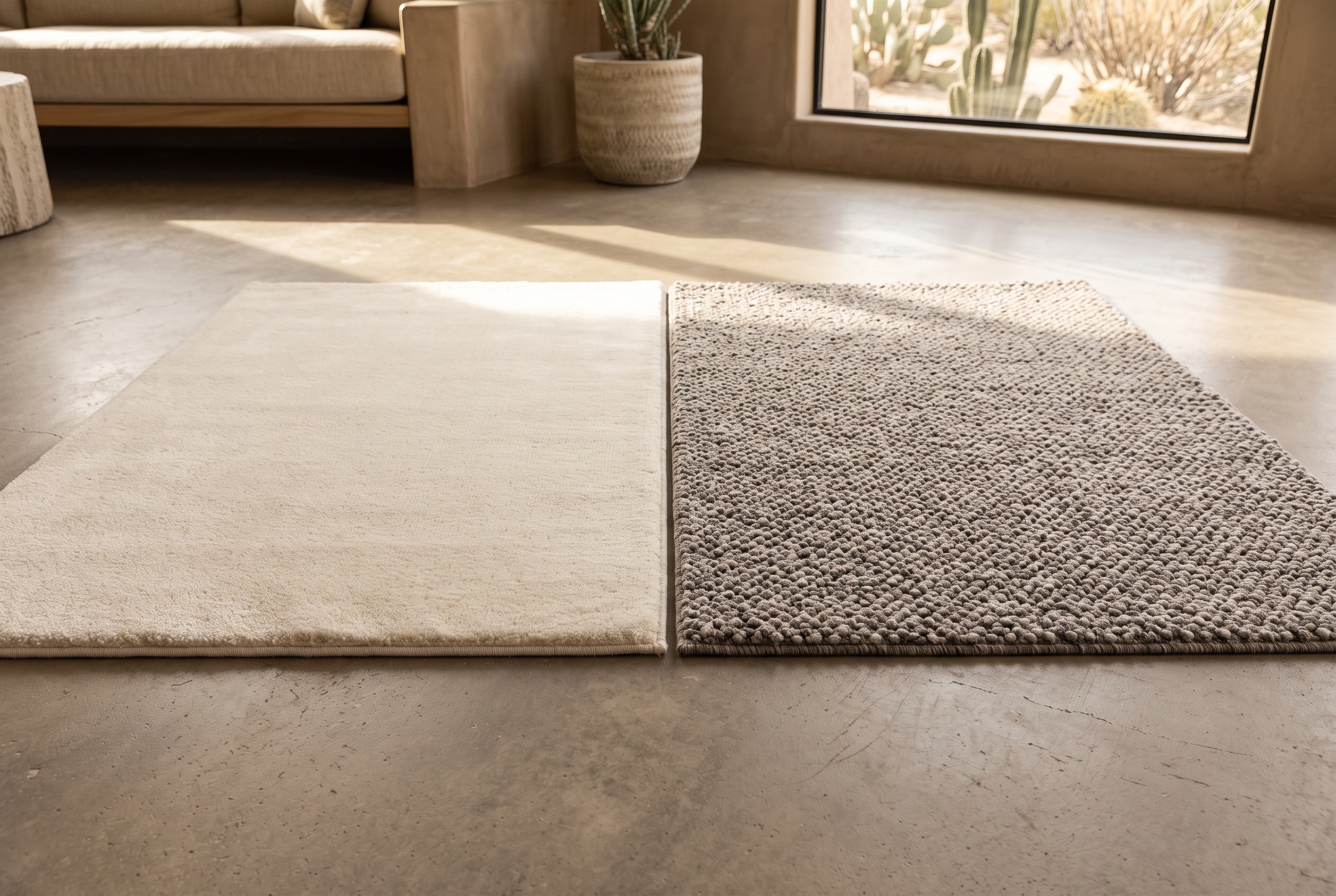
Nylon is the tougher fiber and polyester is the softer, less expensive one. Which is better for your home comes down to three things: how much traffic each room takes, what gets spilled on it, and how much sun it gets. Triexta, which Mohawk sells as SmartStrand, sits between the two and often settles the question.
Stairs, hallways and family rooms: nylon or triexta. Nylon springs back from foot traffic better than any other synthetic fiber, so it keeps its look where people walk most. Triexta comes close and handles spills better.
Bedrooms and guest rooms: polyester. Traffic is light, bare feet notice the softness, water-based spills blot out easily, and the savings can go into a thicker style.
Pets and spills: triexta or solution-dyed fiber. Stain resistance that is part of the fiber does not wear off, and that matters more than the fiber's name when accidents happen.
Rooms with big sunny windows: solution-dyed fiber. Color that runs all the way through the fiber stands up to our sun far better than color added afterward.
Rentals and tight budgets: a dense polyester. How a carpet is built matters as much as its fiber, and a tightly made polyester will outlast a thin, loose nylon.
| Fiber | Best for | Strength | Trade-off |
|---|---|---|---|
| Nylon | Stairs, halls, family rooms | Springs back from traffic | Needs stain protection |
| Polyester (PET) | Bedrooms, guest rooms | Soft, sheds water spills | Less springy in heavy traffic |
| Triexta (SmartStrand) | Busy homes, pets, kids | Built-in stain resistance | Costs more than polyester |
| Wool | Living rooms, bedrooms | Natural spring, hides soil | Highest price, gentle care |
| Polypropylene | Berber, budget, damp areas | Fade and water resistant | Least springy, holds oils |
What Nylon and Polyester Carpet Are Made Of
Nylon and polyester carpet are both made from plastics spun into yarn, but the two fibers behave differently underfoot. Nylon is a polyamide, a tough, elastic fiber that has been the standard for long-wearing carpet for decades. Polyester in carpet is almost always PET, the same plastic used for drink bottles, and much of it is made from recycled ones. Mohawk, one of the makers we carry, turns reclaimed bottles into PET carpet fiber.
Triexta is a newer member of the polyester family with a federal name of its own. Wool, the natural option, and polypropylene, the budget synthetic, round out what you will see when you shop for carpet.
Not sure what is in the carpet you have now? Check the label on the back of a leftover piece or your installation invoice. When you shop, our catalog lists the fiber for every style and lets you filter by it.
Which Lasts Longer in Heavy Traffic
Nylon lasts longest in heavy traffic, because it springs back after being stepped on better than any other synthetic fiber. Polyester recovers less, so in a busy hallway it flattens and loses its texture sooner. In a bedroom, the difference hardly shows.
Judge your traffic room by room. Count the people and pets who use the room every day, notice whether shoes come off at the door, and check whether the room sits on the path from the garage or the back door. Stairs are always the heaviest traffic in the house, since every step lands on the same few inches. A hallway in a family of five with a dog is heavy traffic; a guest room is light.
Carpet rarely wears through to the backing. It looks old because the pile flattens, which carpet people call crushing, and because the twisted yarn tips open up and tangle, which is matting. So the warranty term that speaks to looks is texture retention, not wear. Nylon's real advantage is that its fiber rebounds, so its texture lasts longer under the same feet.
Polyester is still the right choice in a busy room more often than you might think. If you are carpeting a rental you plan to refresh in a few years, or the budget has to stretch across the whole house, a dense, tightly twisted polyester gives you most of the look for less.
Construction does as much work as fiber here. More yarn, packed closer, twisted tighter, at a shorter pile height, stands up to traffic better in any fiber. The pad matters too: a firm pad of the right thickness keeps carpet from flexing too much with each step, which helps any fiber hold its texture.
Which Resists Stains Better
Polyester resists most household spills better than untreated nylon, and nylon resists oily stains better than polyester. Polyester and triexta take up very little water, so juice, coffee and wine tend to sit on the fiber long enough to blot away. Nylon has open spots in its structure that grab dye, so nylon carpet relies on a stain-resist treatment, or color built into the fiber, to keep up.
Polyester's weak spot is oil. Cooking grease, lotion, sunscreen, body oils and the oily film that rides in on shoes are drawn to polyester and to polypropylene, so a spot can look clean and then darken again as it picks up dirt.
Blot oily spills right away with a little dish soap in warm water, rinse with plain water, and blot dry. A professional hot-water cleaning does the rest, because heat and agitation break the bond between oil and fiber.
The spills that matter most in a St. George home behave differently on each fiber:
- Red dirt and clay: let it dry, vacuum it up, then blot what is left with water. Every fiber handles it better dry than wet, and polyester and triexta let go of it most easily.
- Coffee, wine and juice: polyester and triexta shed them well, and treated or solution-dyed nylon handles them if you blot promptly.
- Pet accidents: blot, rinse with water and use an enzyme cleaner made for carpet. Speed and what is under the carpet matter more than the fiber.
- Grease, lotion and sunscreen: nylon lets go of these more easily; on polyester, use the dish-soap step and rinse well.
No carpet is stain-proof, whatever the label says. Stain resistance buys you time to blot, and topical treatments wear down with traffic and cleaning, so act early. Whatever the fiber, blot from the outside in, never scrub, rinse out any cleaner, and keep bleach off carpet, because it can damage the backing even when the color holds.
Which Feels Softer Underfoot
Polyester and triexta usually feel softer than nylon at the same price. Much of that softness comes from very fine filaments, though, not from the fiber's name, and makers spin soft nylons too. If softness matters most, compare samples with your bare feet and hands rather than reading the fiber line.
Soft does not have to mean fragile. Softness comes from fine filaments and durability from spring-back and density, so a soft triexta or a soft nylon can wear well in a busy room. What a very soft carpet does do is show footprints and vacuum stripes more than a textured style, and grip a vacuum hard enough that it is tough to push. Neither is a defect, and both are easy to live with once the vacuum is set right.
Fading in Sunny St. George Rooms
Fading is the main risk for carpet in a room with big west- or south-facing glass, so choose solution-dyed fiber there. Solution dyed means the color is added while the fiber is still liquid, so it runs all the way through, like the color in a crayon. Fiber dyed after it is spun carries more of its color near the surface, where strong sun and harsh cleaners can lighten it.
Most polyester and triexta carpet is solution dyed, and so is polypropylene. Nylon comes both ways, so check the label. Our carpet catalog has a Fade Resistant filter that narrows the choices to styles built for sun.
Even fade-resistant carpet does better with some shade. Treat it like any colored fabric and keep the harshest afternoon sun off it, which is where window coverings earn their keep. Our post on why new floors need the right window coverings in Southern Utah covers that side of it.
Where Triexta and SmartStrand Fit
Triexta is a polyester-family fiber made from a polymer called PTT, and the Federal Trade Commission gave it a name of its own in 2009, at the request of the companies that developed it. Mohawk sells it as SmartStrand. It is soft like polyester, springier than ordinary polyester, and its stain resistance comes from the fiber itself rather than from a coating that wears off.
Mohawk describes SmartStrand as having permanent stain resistance, spill and soil protection, durability and softness, and it is one of the lines we feature on our brands page. It suits busy family rooms, homes with kids and pets, and anyone who wants a soft carpet that can take a spill.
Triexta or nylon? Pick triexta when spills, pets and softness top your list. Pick nylon for the very hardest traffic, such as stairs in a large household, or when a nylon style simply fits the room and the budget better. Both are strong choices for a family room.
Triexta or ordinary polyester? Triexta costs more, usually close to nylon, and it buys you better spring-back and built-in stain resistance. In a guest room that sees a few visitors a year, plain polyester is the better value.
Read the fiber line before you buy. Our catalog lists both triexta and triexta blends, and a blend behaves partly like the other fiber in it. Like the rest of the polyester family, triexta treats oily spills differently from water-based ones, so blot grease and lotion promptly.
Wool, Polypropylene and Blends
Wool is the natural fiber and the premium choice. It is naturally springy, hides soil well, and has a depth of color that synthetics imitate. It costs the most and wants gentle care: a suction-only vacuum, cleaners labeled safe for wool, and a cleaner who knows wool. Wool carpet made in the United States is treated to resist moths.
Polypropylene, also called olefin, is the budget synthetic. Because it is solution dyed, it shrugs off sun and most water-based stains, and it shows up most often in Berber loops and in carpet for commercial spaces. It springs back the least of the common fibers, so it works best in a tight loop where crushing shows less.
Blends mix fibers to balance cost and performance, such as wool with nylon, or triexta with polyester. Our catalog lists blends under their own filters, so you can see what is in each style before you order a sample.
How to Read a Carpet Label
Face weight, density and twist on a carpet label tell you as much about how it will wear as the fiber does. Two carpets of the same fiber can last very different lengths of time because one has more yarn, packed tighter and twisted harder. Ask for the spec sheet on any style you are considering; these are the lines that matter.
| On the label | What it means | Look for |
|---|---|---|
| Face weight | Ounces of yarn per square yard | Compare with pile height |
| Density | How close the tufts are packed | Little backing when bent |
| Twist | Turns of yarn per inch | Tighter for busy rooms |
| Pile height | How tall the yarn stands | Shorter for traffic, stairs |
| BCF or staple | Continuous or short spun fiber | Staple sheds at first |
| Solution dyed | Color through the fiber | Sunny rooms, pets |
Face weight is the number quoted most, and on its own it misleads. A tall, loose shag can weigh more than a short, dense carpet that will last far longer. Density tells you more, and you can judge it when you compare samples: bend each one backward over your finger, and the less backing you see between the tufts, the denser the carpet.
Twist matters most in cut pile. Tightly twisted yarn holds its texture, while loosely twisted yarn opens up and mats. Look at the yarn tips: crisp, tight tips are a good sign in a carpet meant for a busy room.
The pile type changes both the look and the wear. Plush and saxony are smooth cut piles that feel luxurious and show footprints. Textured and frieze cut piles twist the yarn so the surface hides marks and dust. Loop pile, Berber included, is tough and low but can snag, and cut-and-loop mixes the two in a pattern.
BCF yarn is one continuous strand. Staple yarn is spun from short lengths, and staple carpet sheds loose fiber for its first months, which is normal and harmless.
Last, read the warranty categories. Most residential carpet warranties list wear, texture retention, stain and soil coverage separately, and some lines add pet coverage. The industry does not treat matting or crushing as a defect unless the warranty covers them, so texture retention is the line that speaks to how a busy room will look. The paperwork for the style you choose is what counts.
The Best Carpet Fiber for Pets
For pets, the fiber matters less than three other choices: stain resistance built into the fiber, a cut pile instead of loops, and a pad that keeps accidents from soaking through. Triexta and solution-dyed fibers handle accidents best, polyester handles most of them well, and treated nylon stands up to claws and running.
Claws catch in loops, so cut pile is the safer construction with dogs and cats, and a pulled loop in Berber can run. A color close to your pet's coat hides hair between vacuumings, and a textured or flecked style hides it better than a solid plush.
Accidents are the bigger test. Urine reaches the pad and the subfloor quickly, and the pad is where odor settles, so a moisture-resistant pad does as much for a pet home as the carpet on top of it.
Some lines carry warranties that cover pet accidents. Mohawk backs its PETPremier carpet, a PET polyester we feature, with its All Pet warranty. As with any warranty, the paperwork for the style spells out what is covered.
Nylon or Polyester for Stairs, Bedrooms and Rentals
Stairs, bedrooms and rentals each call for a different fiber and construction, and most homes end up with more than one carpet. Match each room to its traffic, its spills and its sun.
Stairs and Hallways
Stairs and hallways take the hardest wear in the house, so choose nylon or triexta in a dense, low cut pile or a tight texture. Every step lands on the same spot, and the nosing bends the carpet over its edge, which opens up a loose or tall pile until the backing shows. Large loops are a poor match for stairs, because the bend spreads them apart and heels and claws catch them. A dense, low carpet also gives surer footing on the steps.
Family Rooms and Living Rooms
Family rooms want nylon or triexta, especially with kids or pets. A textured or frieze style hides footprints, crumbs and the red dust that finds its way in, and a mid-tone color shows less than a very light or very dark one. Most homes here sit on concrete slabs, so carpet goes over the slab with a pad beneath it, and that pad does much of the work of making a family room feel soft.
Bedrooms, Guest Rooms and Playrooms
Bedrooms are where polyester does its best work. The traffic is light, bare feet notice the softness, and the money saved can go into a plusher style. In a child's room or a playroom, where juice, crayons and slime happen, step up to triexta or a solution-dyed style. The same goes for a bedroom the dog shares.
Home Offices
A home office chair rolls over the same patch of carpet all day and grinds it flat. Choose a dense, low pile in nylon or triexta, and put a chair mat under the casters whatever the fiber.
Rentals and Vacation Homes
Short-term rentals and second homes around St. George see heavy traffic in short bursts and need carpet that cleans up between guests. A solution-dyed polyester or nylon in a dense, textured style and a forgiving mid-tone works well, and the same thinking fits a guest casita. Use one style throughout the property so leftover carpet can patch any room.
How long it lasts depends on traffic and construction more than on fiber. The length of the texture-retention warranty on a style is a fair sign of how long its maker expects it to keep its look. We take on both residential and commercial jobs.
What Moves the Price of Nylon and Polyester Carpet
Polyester is usually the least expensive of the main fibers, nylon costs more, triexta lands near nylon, and wool costs the most. Within each fiber the spread is wide, and construction moves the price as much as the fiber does.
More yarn costs more, so a denser, heavier carpet in the same fiber is priced higher, and brand and line matter too. The rest of the total comes from the job:
- The pad, which varies in thickness, density and moisture protection.
- Removing and hauling away the old floor.
- Stairs, which take far more labor per square foot than an open room.
- Moving furniture.
- Transitions where carpet meets tile, wood or vinyl.
- Waste from room shapes and pattern matching, since carpet comes off wide rolls.
We price each job at a free estimate, based on your rooms and the style you choose. If spreading the cost helps, our financing options include project loans and the Mohawk credit card program.
When Carpet Mats, Fades or Won't Come Clean
Matting, fading and stains that keep coming back are partly fixable, and partly the old carpet telling you what to choose next time.
Matted lanes look better after slow vacuuming against the pile and a professional hot-water cleaning, which lift soil and fluff the yarn. They do not re-twist, so a lane that is still flat and fuzzy after cleaning is worn. For the next carpet in that room, a springier fiber or a denser construction is the fix.
A spot that reappears after it dries is usually wicking. The spill soaked into the backing or pad and is climbing back up, or leftover soap is grabbing dirt. Blot with plain water, then lay several white towels on it with something heavy on top overnight to draw the moisture up. On polyester, an oily spot that keeps darkening needs the dish-soap step and a thorough rinse.
A faded strip cannot practically be re-dyed in place. A patch from leftover carpet can replace a small area, which is the best reason to keep your leftovers rolled up in a closet. The next carpet in that room should be solution dyed.
Comparing Carpet Fibers With Us
Samples tell you more than any spec sheet, and at Sunset Flooring in St. George we make it easy to compare fibers side by side before anything is ordered. Our carpet catalog lets you filter by fiber, including nylon, polyester, polypropylene, triexta, wool and their blends, and by fade resistance. It carries makers such as Shaw Floors, Mohawk, Masland, Fabrica, Anderson Tuftex and Dream Weaver.
You can have samples sent to your door and test them on your own floor, in your own light, with your own pets. If you need carpet down soon, start with the carpet we keep in stock.
If you would rather talk it through, book a design consultation, or come see the full range at our showroom on East Gateway Drive. Bruce and Beckie Barber have been providing flooring and installation in Southern Utah since 1991.
Questions People Ask About Carpet Fibers
Does Nylon Carpet Cause More Static?
Yes, nylon tends to build a little more static than polyester, and our dry desert air makes any carpet worse. A humidifier in the drier months, an anti-static treatment and leather-soled slippers all help. If shocks bother you, ask about anti-static properties when you compare spec sheets.
Is Polyester Carpet the Same as PET Carpet?
Yes. PET is the most common type of polyester used in carpet, so the two names usually mean the same fiber. Triexta is a close cousin in the polyester family, sold under its own name.
Which Carpet Fiber Is Most Eco-Friendly?
It depends on what matters most to you. Recycled PET gives used plastic bottles a second life, and Mohawk is among the makers turning bottles into carpet. Wool is natural and renewable. Whatever you choose, look at the maker's own environmental claims for that line, and look for the Green Label Plus mark for low emissions.
Is the New Carpet Smell Harmful?
No. The Carpet and Rug Institute calls the slight smell of new carpet harmless, and it fades quickly. Open the windows and run your heating and cooling fan for up to three days after installation. Carpet, pad and adhesive that carry the Green Label Plus mark have passed independent lab tests for very low emissions.
Once you know which fiber suits each room, put the samples on your own floor and let us price the whole job. Book your free estimate with one of our project specialists.